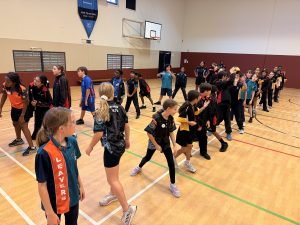
Year 10 Camp 2024 Highlights

This year, our Year 10 students headed out to the scenic Yanchep National Park for three days for a memorable adventure camp experience! Based in the recently restored Gloucester Lodge, the year group spent the time being challenged through a variety of outdoor activities and as they battled through the rainy weather all camp long.

Staying in the Yanchep National park allowed students to get outside and into nature by participating in the Treetops Adventures high ropes course, a tour of the Crystal Cave and Boomerang Gorge, hikes and even spotted a few koalas!

Time for rest and relaxation included beach games (plus a few brave souls who ventured into the icy water!) night games as a group and a scenic wildflower walk.

Not only did this camp provide an opportunity for adventure and fun; it is a key part of building community into our College’s year groups. As our students spent time making memories together on camp, we pray that they will continue to bond in a classroom environment – now and in the years to come.

Year 8 Salvation Army Homeless Sleepout

September saw our Year 8 students taking part in a Homeless Sleepout supported by the Salvation Army. This event aims to raise awareness around the challenges faced by unhoused Australians. For our students, this was a wonderful opportunity to grow in empathy and understanding towards members of our community who are doing it tough.

With little more than a sleeping bag, our students spent the night gaining firsthand experience into what sleeping rough can feel like. This was followed by a day of engagement in different community service activities, where our Year 8s were able to give back to our local community and continue to grow in compassion towards others.

We are so proud of our students and their willingness to love and serve their community!

Year 6 Camp Highlights

Ellenbrook Christian College Year 6 students have spent the last week of term away on camp in Albany, where they’ve had a fantastic time! A range of exciting activities has allowed our students to connect with nature, learn about the rich history of the Albany area, and participate in some healthy competition.

Day one began with laser tag, the perfect opportunity for our students to show off their strategy (and aiming) talents and build teamworking skills in a fun environment.

The Albany area is full of exciting learning opportunities related to the history of the region and its beautiful natural environment. Our Year 6 students visited the Brig Amity, where they discovered what life on board a convict ship was like and its links to the European settlement of WA. Students also learned about the history of whaling in the area and the impacts of that industry on our natural environment. They may have even spotted a whale or two in the Sound!

Moving outside, the they travelled to the Valley of the Giants to climb the treetop walk together, taking in the beauty of the karri trees. They also visited the Albany Wind Farm, experiencing the beautiful combination of coastal scenery and information on renewable energy. Did you know that the Wind Farm produces enough energy to power over 24,000 homes?

Other highlights of the camp included visiting the Albany War Memorial and playing rounds of ping pong back at the camp grounds. It has been a memorable experience for everyone, filled with fun and making memories together!

Core Values: What does Character mean for our College?

WORDS: Michelle Cockrell 

As you walk through our campus, you may notice three key words displayed prominently: Character, Commitment, and Community. These core values are not just ideals but the very foundation of who we are and what we strive to nurture in our students. At our College, we are dedicated to the holistic development of each child, recognising that education goes beyond academic achievement. By teaching and modelling these values, we prepare our students to navigate a rapidly changing world with confidence, integrity, and purpose.

Character reflects the development of moral and ethical strength, such as honesty, integrity, and perseverance. 

Commitment emphasises dedication, hard work, and perseverance towards goals or causes, such as lifelong learning and service. 

Community highlights the importance of relationships, working together, and building a supportive environment that fosters growth and mutual respect. 


What does character mean for our College community?

Cambridge Dictionary defines character as “the particular combination of qualities in someone or something that makes them different from others”. In other words, character shapes how we act, the decisions we make, and how we interact with others. But beyond the dictionary definition, character is something deeply planted in the way we choose to live our lives. For us as a Christian College, character is about reflecting Christ-like qualities in all we do. 

The Bible offers a clear vision of character in Galatians 5:22-23, which lists the Fruit of the Spirit: “love, joy, peace, patience, kindness, goodness, faithfulness, gentleness, self-control.” These are characteristics that define a life lived in step with God and one another.

As we pursue these virtues—love, joy, peace, patience, and the rest—we are living out the character of Christ. Take patience, for example. In a fast-paced world that often encourages instant gratification, patience teaches us to wait on God’s timing, to endure hardships, and to show grace to others. Similarly, kindness and gentleness are vital in building strong relationships with our peers, teachers, and wider community, reflecting the heart of Christ in our daily interactions. Self-control, also one of the fruits of the Spirit, plays a foundational role in shaping character. It equips individuals to make wise decisions, and act with discipline even in challenging circumstances. By practicing self-control, students learn to navigate difficult situations with grace and maturity. This strength of character not only benefits their personal development but also allows them to contribute positively to the community around them.


So, how can we apply this to our own lives?

Small Acts, Big Impact:  Building character isn’t always about grand gestures. It’s the small, everyday decisions—choosing to be kind when it’s difficult, remaining peaceful in stressful situations, or showing self-control when tempted—that help us grow into people of character.

Learn from Others: In our College community, we are surrounded by role models—teachers, leaders, friends—who exemplify these virtues. By observing and learning from them, we can grow in our own character.

Commit to Growth: Developing character is a lifelong process. It requires commitment and the willingness to keep growing, even when we stumble. Through prayer, reflection, and community support, we can continue to develop the fruit of the Spirit in our lives. 

Our aim is to be a College of character, where we encourage one another to strive for these qualities. We aspire to be people of character—steadfast in love, rich in kindness, and grounded in faith.

Reading Academy Success: literacy support programs boost Primary students’ skills

Scarborough's Reading Rope

Term 3 saw the Year 1s complete the Year 1 Phonics Check: a simple test which assesses their ability to read real and nonsense (made-up) words.
However, whilst the test was simple, learning to read is anything but.

Dr. Hollis Scarborough created a diagram in the late 1990s to demonstrate the essential strands of reading and how they come together to create a
fluent and proficient reader. The rope is split into two sections: word recognition and language comprehension. Word recognition allows us to fluently and accurately recognise the letters and words on the page, it includes phonological awareness, phonics and sight recognition.

Language comprehension allows us to understand what we are reading by extracting meaning when we read and includes vocabulary, background knowledge, language structures, literacy knowledge and verbal reasoning. Learning to read is difficult and requires a systematic approach which is developmentally appropriate.

The Primary Reading Pledge stated that in 2023, “almost 90,000 [Australian] students started their secondary studies with below proficient literacy levels.” If reading is difficult for students, it makes sense that they would avoid it; however, this impacts their ability to comprehend texts, produce quality sentences, reduces their understanding of
text organisation and limits their vocabulary.

So, what can we do to help our children become fluent and proficient readers?

  • Keep reading to your children – whilst it might not help with the ‘learning to read’ process, it will build solid comprehension skills. Ask open-ended questions about the story and build critical thinking skills. Audiobooks are also a good option!
 
  • Build your child’s vocabulary – use new words in everyday conversations. This assists with their contextual understanding of the word as well.
 
  • Depending on the age of your child, play games such as “I Spy” when you go shopping, for example, “I spy with my little eye, something beginning with “o” (the sound, not letter name).
 
  • Engage with educational apps, such as Nessy, to help build foundational reading skills.
 
  • Ask your child to summarise what they have read (or watched) to help build their oral skills which assists with writing skills.
 
  • Utilise the speech to text or text to speech features on computers, iPads and phones, for example, Chrome offers a Read Aloud web extension.
 
  • Encourage your child to employ reading skills – track what they are reading with their finger, break new words
    into syllables and ask for help when a word is unfamiliar (don’t just skip it, it affects comprehension).
 
  • Be a word sleuth and explore the etymology (word origins) and morphology (small units of meaning) of new words. For example, I teach psychology – “psych” means the mind, and “-ology” means the study of, so psychology is the study of the mind.

Engaging in The Reading Academy, created and run by Gillian Falloon, as either a student or mentor, also
provides repeated opportunities for students to improve their reading. If your child (Years 1-3) has been invited to attend Reading Academy, regular attendance is important. Research shows that it takes four times as
many resources to intervene at Year 4; early intervention is the key!

Students in Years 7-12 are encouraged to volunteer to ensure we can maximise the amount of Year 1-3 students involved. If your child would like to volunteer for The Reading Academy, please contact Gillian Falloon.

If you would like to know more about supporting your child’s reading, you can read about the Scarborough Reading Rope here, speak to your child’s teacher (primary) or contact Danielle Grisham via danielle.grisham@ellenbrook.wa.edu.au.

Contact Gillian Falloon here if your child is interested in volunteering for The Reading Academy